
TCC-HM102-100μg / 询价
TCC-HM102-100μgx5 / 询价
TCC-HM102-100μgx10 / 询价
Biotinylated Human KRAS G12D TCR&CD3 Complex Nanodisc
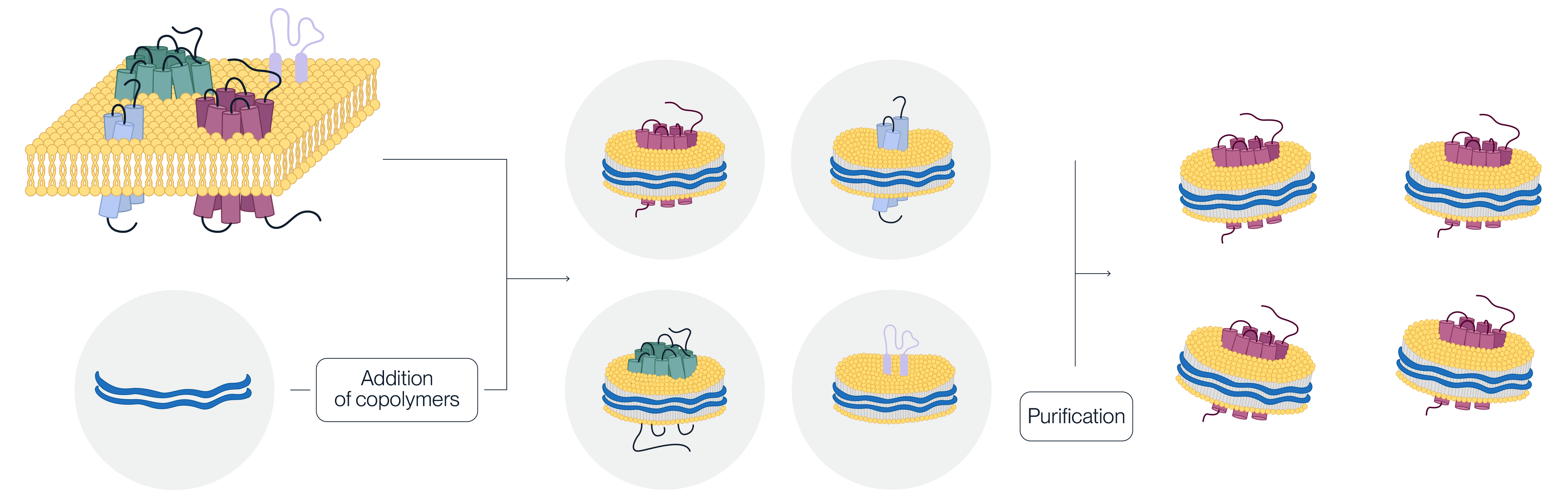
Our Styrene-Maleic Anhydride(SMA) nanodisc platform delivers multi-pass transmembrane proteins exactly as they exist in the HEK293 cell membrane following recombinant expression— preserving their endogenous lipid environment and correct conformational states. Isolated directly from HEK293 cells via a gentle, detergent-free process, the multi-pass membrane proteins are subsequently encapsulated by SMA to ensure their stability. These uniform soluble nanoparticles eliminate extraction interferences while maintaining biological activity. Ensuring consistent performance from lot to lot, our nanodiscs provide the reliability and biological relevance essential for antibody screening and functional characterization in therapeutic antibody drug discovery and development, as assessed by SPR, BLI, ELISA, and other standard platforms.
❖ Correct structure & conformation
❖ Functional relevance ensured
❖ His-tag & biotinylation tag available
❖ Antibody screening
❖ Functional characterization(Molecular Level)
❖ Assay: SPR, BLI, ELISA
Recombinant Biotinylated Human KRAS G12D TCR&CD3 Complex Nanodisc is expressed from HEK293. Both the biotin and the His tag are located on the C-terminus of the KRAS G12D TCR.It contains KRAS G12D specific TCR (JD1a41b1), CD3ε&CD3γ, CD3ε&CD3δ, and CD3ζ dimers
The protein has a predicted MW of 196.0 kDa.
Less than 1 EU per μg by the LAL method.
Supplied as 0.22 μm filtered solution in PBS, 200mM L-arginine (pH 7.4). Notice: Not recommended for flow cytometry.
Valid for 6 months from date of receipt when stored at -80°C.
Recommend to aliquot the protein into smaller quantities for optimal storage. Please minimize freeze-thaw cycles.


The JD1a41b1 TCR is an engineered, high-affinity T-cell receptor that strictly recognizes the peptide fragment of KRAS G12D (VVVGADGVGK) presented on the HLA-A*11:01 only. Cluster of Differentiation 3 (CD3) is a multimeric protein complex and T cell co-receptor that plays an essential role in adaptive immune responses. These CD3 dimers bind non-covalently to the TCR to form the TCR&CD3 complex on the cell surface.
KRAS G12D TCR&CD3
(1) Poole, Andrew, et al. "Therapeutic high affinity T cell receptor targeting a KRASG12D cancer neoantigen." Nature communications 13.1 (2022): 5333. DOI: 10.1038/s41467-022-32811-1. PMID: 36088370, PMCID: PMC9464187